
In New Mexico, family courts decide child support based on the New Mexico child support guidelines and accompanying laws. The two factors that impact child support the most are each parent’s income and time-sharing with the child. Other important factors include work-related childcare expenses, insurance paid for the child, and additional expenses.
Violating a child support order can lead to sanctions. These sanctions can include license suspension, passport denials, tax interceptions, liens, and possibly incarceration.
So, it’s important for anyone facing custody or divorce to understand how family courts decide child support. Also, it’s essential to understand what happens if court ordered child support is violated in New Mexico.
FACTORS INFLUENCING CHILD SUPPORT AMOUNTS
In New Mexico, several key factors influence the amount of child support a parent may be required to pay. One of the most significant factors is the income of both parents. Courts typically use both parents’ gross income to calculate child support, ensuring that the support amount reflects each parent’s financial capacity. This approach helps distribute financial responsibility more equitably between the parents.
Another critical factor is the custodial arrangement. In cases where one parent has primary physical custody of the child, the non-custodial parent is usually required to pay child support to help cover the child’s expenses. However, in joint custody arrangements, where both parents share physical custody, the child support amount may be adjusted to reflect the time each parent spends with the child and their respective financial contributions.
The child’s specific needs also play a crucial role in determining child support amounts. Courts consider expenses related to education, healthcare, extracurricular activities, and any special needs the child may have. For instance, if a child requires ongoing medical treatment or counseling, these additional costs are factored into the child support calculation to ensure the child’s needs are adequately met.
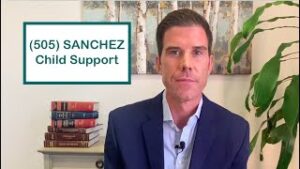
Watch this video to understand how child support is calculated in New Mexico.
UNDERSTANDING COURT ORDERS RELATED TO CHILD SUPPORT
In New Mexico, court orders related to child support are legally binding documents issued by a judge. These orders outline the amount of child support to be paid, the payment schedule, and any other relevant terms and conditions. Once a court order is issued, both parents are legally obligated to comply with its terms. Failure to do so can result in serious legal consequences.
It is essential to understand that court orders related to child support are not set in stone. While they provide a framework for financial support, they can be modified under certain circumstances. However, the party moving to modify the child support order must show a material and substantial change in circumstances. In New Mexico, there is a presumption of a material change in circumstances when:
- Based on the changes the total support owed either goes up or down by at least 20%; and
- The motion to modify is filed more than one year after the existing order was filed.
The person moving to modify child support bears the burden of proving the material change in circumstances.
Court orders related to child support also include provisions for enforcement. So, if a parent fails to meet their child support obligations, the custodial parent can take legal action to enforce the order.
This may involve working with Child Support Enforcement Division (CSED) or filing a motion to enforce.
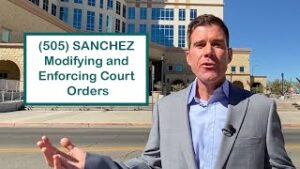
Check out this video to better understand how to modify or enforce a child support order in New Mexico.
COMMON VIOLATIONS OF CHILD SUPPORT ORDERS
Violating child support orders is a serious issue that can have far-reaching consequences. One of the most common violations is the failure to make timely and full child support payments. Some parents may miss payments entirely, while others may make partial payments or consistently pay late.
Another common violation involves underreporting income or hiding assets to reduce child support obligations. Some parents may attempt to manipulate their financial situation to appear less capable of paying child support than they truly are. This can involve tactics such as working under the table, transferring assets to other parties, or underreporting income on financial documents.
CONSEQUENCES OF VIOLATING CHILD SUPPORT ORDERS IN NEW MEXICO
Violating child support orders can result in severe legal consequences. One of the most immediate consequences is the accrual of interest and penalties on unpaid child support amounts. In New Mexico, unpaid child support can incur the statutory interest rate of 4%. See NMSA 40-4-7.3.
Additionally, parents who consistently fail to meet their child support obligations may face sanctions, license suspension, and even imprisonment.
Another significant consequence is the potential for wage garnishment. New Mexico courts have the authority to enter a Wage Withholding Order. A Wage Withholding Order automatically deducts a portion of the parent’s income. This ensures that the custodial parent receives the support owed, even if the non-custodial parent is unwilling to make voluntary payments.
Violating child support orders can also result in the suspension of various licenses. These include driver’s licenses, professional licenses, and recreational licenses. This can have a profound impact on the non-compliant parent’s ability to work and maintain their livelihood. In some cases, the court may also seize tax refunds or place liens on property to collect unpaid child support. These consequences underscore the importance of complying with child support orders and fulfilling one’s legal obligations.
HOW TO ADDRESS CHILD SUPPORT VIOLATIONS IN NEW MEXICO
Addressing child support violations requires a proactive approach and a clear understanding of the legal options available. Is your ex failing to meet their child support obligations? If so, the first step is to document all instances of non-payment or partial payment. Keeping detailed records of missed payments, communication attempts, and any other relevant information can be crucial when seeking enforcement.
Next, consider reaching out to Child Support Enforcement Division (CSED). These agencies are specifically designed to assist custodial parents in enforcing child support orders. They have the authority to take various enforcement actions, such as wage garnishment, tax refund interception, and license suspension, to ensure compliance. Working with the CSED can be an effective way to address child support violations without the need for lengthy court proceedings.
If CSED’s efforts are unsuccessful or if you prefer a more direct approach, you can file a motion for contempt of court. This legal action involves motioning the court to hold the non-compliant parent in contempt for violating the child support order. If the court finds the parent in contempt, they may face penalties such as fines, jail time, or additional enforcement measures.
MODIFYING CHILD SUPPORT ORDERS: WHEN AND HOW
Life circumstances often change. When they do, it may be necessary to modify an existing child support order to reflect your new reality. Modifying a child support order is a legal process that requires approval from the court. It is not something that can be done unilaterally by either parent. Common reasons for seeking a modification include:
- Significant changes in income;
- Changes in the child’s needs; or
- Time-sharing changes.
Do you believe that a modification is necessary? If so, the first step is to gather documentation that supports your claim. This may include recent pay stubs, tax returns, medical bills, or other relevant financial records. Once you have the necessary documentation, you can file a motion with the court requesting a modification of the child support order.
In New Mexico, the court reviews the evidence and determine whether a material change in circumstances has occurred.
In some cases, parents may be able to reach an agreement on a modified child support amount without going to court. If both parents agree to the change, they can draft a stipulated order. This order outlines the new terms and becomes a binding order once filed and signed by assigned judge.
10 COMMON FAQS: HOW FAMILY COURTS DECIDE CHILD SUPPORT AND WHAT HAPPENS IF COURT ORDER IS VIOLATED?
Are you wondering how family courts in New Mexico decide child support and what happens if Court Order is violated?
If so, here are the 10 most common FAQS regarding child support in Albuquerque and Rio Rancho, New Mexico.
WHY IS CHILD SUPPORT SO HIGH IN NEW MEXICO?
Child support can seem high because of the 2024 updated child support guidelines. You see, the 2024 child support guidelines result in a higher child support amount. In part, this increase is caused by the increased cost of living in New Mexico.
Additionally, parents that have a child less than 35% of the time (less than 128 days per year) are on a Worksheet A. Consequently, Worksheet A results in a higher amount of child support paid to the primary parent. So, parents with less than 128 days per year often feel that child support is too high.
With that said, some parents believe that child support is too low. This belief may be based on inflation and the increased cost of living.
Do you believe that child support is too high or too low? Either way, it’s essential to talk with an experienced child support lawyer in New Mexico. An experienced lawyer can help you understand how child support is calculated in Albuquerque and Rio Rancho.
CAN CHILD SUPPORT SUSPEND YOUR LICENSE IN NEW MEXICO?
Yes. Failing to pay court ordered child support can result in your license being suspended. However, the following steps must first be taken before one’s license is suspended:
- There must be court ordered child support payments;
- Court ordered child support payments must be missed;
- A Motion to Enforce or Motion for Order to Show Cause must be filed; and
- A Hearing must be held regarding the missed child support payments.
In New Mexico, the court usually gives the non-paying parent a chance to make payment before suspending a parent’s license. Nevertheless, repeated failures to pay for child support can result in a parent’s license being suspended.
CAN CHILD SUPPORT BE GARNISHED IN NEW MEXICO?
Yes, child support can be garnished in New Mexico with a Wage Withholding Order. In turn, the garnished income generally is handled by Child Support Enforcement Division (CSED).
WHY DOES CHILD SUPPORT STOP AT 18?
In New Mexico, child support generally ends at 18 when a child becomes an adult. Generally, child support continues until the minor child turns 18, unless the child is still attending high school. If so, support continues until the child completes high school or turns 19, whichever happens first.
However, parents may have the duty to support a severely disabled child if the child was disabled before 18. In New Mexico, whether the child is severely disabled depends on a number of factors. Ultimately, the assigned judge decides if the child is severely disabled and entitled to continuing child support past 18.
WHY IS THERE CHILD SUPPORT IF 50/50 CUSTODY OR TIMESHARING?
In New Mexico, a parent may still be ordered to pay child support even if the parents are sharing 50/50 timesharing. This occurs because child support is based on the following factors:
- Each parent’s gross monthly income;
- Work-related daycare expenses;
- Insurance premiums paid for the child; and
- Extraordinary expenses.
So, even though the parents share 50/50 timesharing, New Mexico courts consider all the factors. Therefore, based on the factors above, a parent with 50/50 visitation may still be required to pay child support.
With 50/50 timesharing, most commonly, the parent with a higher gross monthly income is still required to pay child support. Nevertheless, other factors can result in child support being paid when parents share 50/50 custody.
HOW MANY CHILD SUPPORT PAYMENTS CAN BE MISSED BEFORE JAIL?
How many child support payments can be missed before jail depends on your family court judge. Also, it depends on how many times the court has addressed the missed payments and if sanctions have been ordered.
Usually, family court judges are reluctant to throw parents in jail for missed payments. However, the court can order jail time for parents that repeatedly refuse to pay child support.
HOW OFTEN CAN CHILD SUPPORT BE MODIFIED?
Under New Mexico law, child support can be modified one year after the current child support order was entered. However, the parent requesting the modification must prove a material change in circumstances has occurred.
A material change in circumstances means that the current child support goes up or down by at least 20%. This 20% increase or decrease is based on all of the updated factors. These factors include:
- How much time the child spends with each parent;
- Each parent’s gross monthly income;
- Work-related childcare expenses;
- Insurance premiums paid for the child; and
- Qualifying Extraordinary expenses.
So, child support can be modified once a year if all the factors change the total support by 20%.
WHICH STATE IS CHILD SUPPORT DETERMINED?
Child support is determined by the state where the parentage or divorce case is filed. In New Mexico, parents must live in New Mexico for six consecutive months before opening a divorce case.
Moreover, a parentage case can be opened when New Mexico is the home state of the child. Usually, New Mexico is considered the child’s home state if the child has lived in NM for 6 consecutive months.
So, child support can be determined in New Mexico either through a divorce or parentage case filed in family court.
WHICH PARENT PAYS CHILD SUPPORT?
In New Mexico, which parent pays child support depends on the following factors:
- Each parent’s timesharing with the child;
- Each parent’s gross monthly income;
- Work-related childcare expenses;
- Insurance premiums paid for the child; and
- Qualifying Extraordinary expenses.
The two biggest factors impacting which parent pays child support are time-sharing and each parent’s gross monthly income.
WHICH COURT DO I FILE FOR CHILD SUPPORT IN NEW MEXICO?
In New Mexico, you file for child support in the county where you and the child live. Moreover, you can file for child support either through a divorce or parentage case.
So, Albuquerque residents file for child support in Bernalillo Count (2nd Judicial District Court).
Los Lunas/Belen residents file for child support in Valencia County (13th Judicial District Court).
Rio Rancho residents file for child support in Sandoval County (13th Judicial District Court).
Finally, Santa Fe residents file for child support in Santa Fe County (1st Judicial District Court).
Usually, you must have lived in New Mexico for 6 consecutive months before filing for child support.
HOW TO ENSURE COMPLIANCE AND SUPPORT FOR CHILDREN
Ensuring compliance with child support orders and providing adequate support for children is a shared responsibility. This responsibility requires cooperation, understanding, and a commitment to the child’s best interests. Navigating the complexities of child support decisions and addressing violations can be challenging. However, understanding your rights and options is crucial for protecting your family’s well-being.
Ultimately, the goal of child support is to prioritize the well-being of the child. Also, child support helps ensure that children have access to the resources they need to grow and succeed.
Are you going through a divorce or child custody case and have questions about child support? If so, possibly you want a quick and painless uncontested divorce in Albuquerque or Rio Rancho, New Mexico. Alternatively, your divorce case may involve abuse and a restraining order involving children.
In either case, call (505) SANCHEZ and talk with New Mexico’s best uncontested divorce and top-rated restraining order of protection lawyer. Our team of no fault divorce lawyers routinely handle child support issues in New Mexico.